


Stop unsuitable agent ideas before they consume budget and credibility.
Make agents fit for work.
Your agent can do the task. Can your business rely on it?
CARE shows whether an agent fits the job, process, people and system landscape, and what must change before your organization depends on it.
Start free. Use CARE with agents built on any platform.
Expose what the process, people and systems must provide.
Establish boundaries, responsibility and intervention that hold in reality.
Establish one standard of CARE across every agent initiative.
Why CARE matters
CARE defines where agents belong in your organization.
Shadow AI and gatekeeping are two sides of the same coin: One creates the other.
In that arms race, progress, performance and trust are sacrificed.
The cycle CARE breaks:
-
AI enthusiasm
-
Unclear prerequisites
-
Systemic friction
-
Gatekeeping
-
Shadow AI
CARE breaks the cycle, not the goal.
-
Create structure
Define where the agent belongs, what the surrounding process must provide, and what should not be delegated.
-
Assign accountability
Make ownership, intervention responsibility and decision boundaries explicit before they become urgent.
-
Build confidence
Evaluate new agent ideas consistently, without relying on personal judgment, political leverage or undocumented knowledge.
Teams taking CARE work with, not against, each other.
What CARE reveals
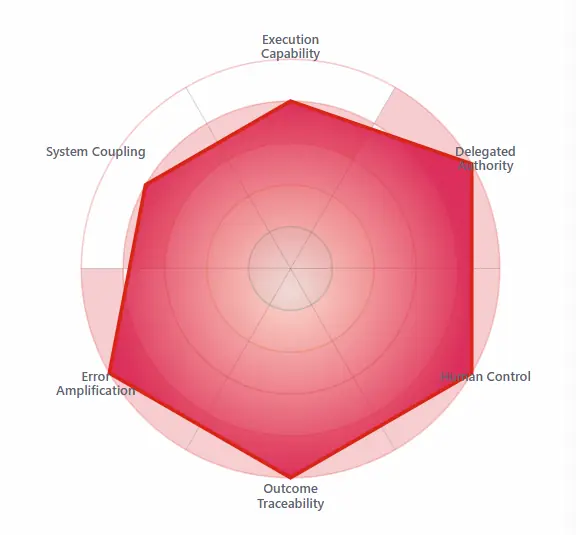
Every agent creates exposure. Every organization has a different ability to control it.
A risk surface
A control surface
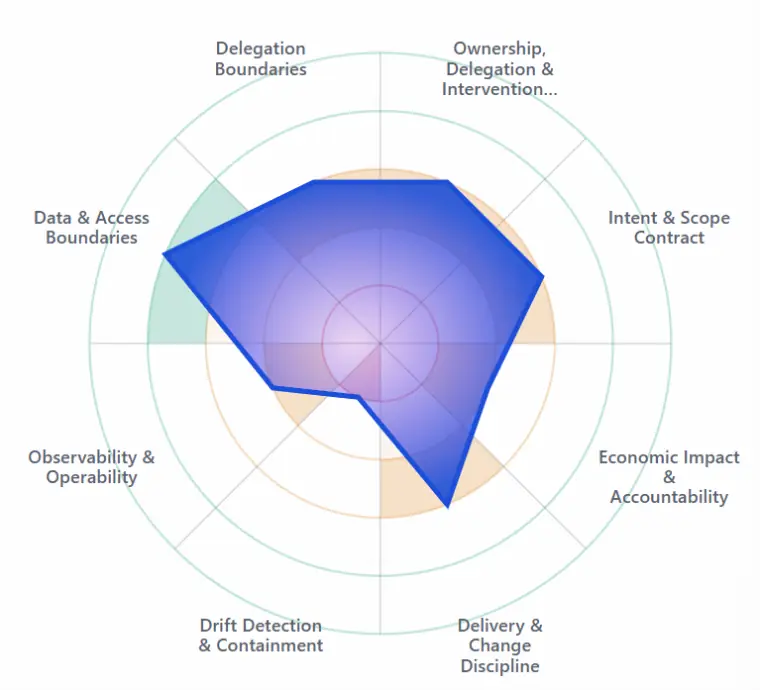
CARE makes these surfaces visible.
When risk exceeds control, your options are de-risking the agent, or optimizing the surrounding process. CARE gives you options.
Incidents are a consequence
The decisions that made them possible happened much earlier.
CARE to see the risk before it becomes an incident?
Keep your tech stack.
A workflow is not a working arrangement.
Your agent tools make it capable
- models and prompts
- tools and integrations
- execution logic
- runtime and evaluations
CARE makes the arrangement workable
- a viable job
- a capable process
- responsible people
- suitable systems
- authority and limits
- necessary changes before operation
Your tools manage the agent's technology. CARE manages how your business puts it to work.
CARE finds the problems your demo cannot.
Stop bad bets early
Find out whether the job, value and process are suitable before implementation momentum makes stopping expensive.
Keep prerequisites out of delivery scope
Expose missing owners, decisions, process capability, feedback and dependencies before implementers inherit them.
Make the agent fit the business
Align its role with the people, process, systems, authority and customer experience surrounding the work.
Make limits hold
Distinguish between an instruction, a monitored rule and a boundary the agent cannot bypass.
If the agent can choose to ignore it, CARE does not count it as a control.
HR is for people. CARE is for agents.
A successful demo is not a hiring decision.
You would not employ someone because they produced one plausible answer during an interview. You define the job, check whether they are qualified, onboard them into the organization, establish responsibilities, develop their capabilities, review their performance and eventually offboard them.
CARE does the equivalent for agents.
-
Recruit
Decide whether there is a viable job for an agent.
-
Qualify
Determine whether the agent and its working environment are suitable.
-
Onboard
Give it a role, owner, team, authority, boundaries and process context.
-
Develop
Identify missing capabilities and organizational prerequisites.
-
Manage
Review performance, reassess readiness and intervene when conditions change.
-
Offboard
Retire the agent without erasing its decisions, responsibilities and history.
Your builder creates the agent. CARE manages its working life.
CARE does not pretend that agents are people. It applies the same organizational discipline to the work they perform.
Same agent. Different ways it can fail.
Everyone discovers a different failure. CARE makes it one working arrangement.
For companies
Agents are doing work. What happens at 2 a.m.?
When something goes wrong, responsibility cannot begin with searching for whoever built it.
For implementers
If the agent does not fit its organization, delivery becomes a tug-of-war.
Expose what the client must provide before it becomes delivery scope.
For operators
The logs look fine. Users and customers disagree.
Green logs cannot tell you whether the operation still works for users and customers.
For agent owners
Building the agent is the easy part. Getting one you can trust isn't.
See what the agent still needs before people can rely on its work.
Put one real agent in CARE.
See what it still needs.
-
1
Register it
Planned, in development or already operating.
-
2
Describe the working arrangement
Work through the job, process, people and systems with those who know them.
-
3
See what must change
CARE makes missing prerequisites, responsible people and next actions visible.
Keep CARE current as the agent and its working environment change.
CARE has owners, too.
Built by people you can actually reach.
CARE asks organizations to make responsibility visible. We hold ourselves to the same standard. These are the people responsible for the product, method and customer relationship.
 Michael Küsters
CEO, Founder, Head of Product
Owns CARE product direction and method.
Michael Küsters
CEO, Founder, Head of Product
Owns CARE product direction and method.
- Founder of Intelygence; Head of Product for CARE
- Organizational change and agile coaching across enterprises
- Author on organizational design and agile practice
 Kangbo Wan
Chief Sales & Marketing Officer, Co-Founder
Owns CARE customer relationships and go-to-market.
View profile
Kangbo Wan
Chief Sales & Marketing Officer, Co-Founder
Owns CARE customer relationships and go-to-market.
View profile
No anonymous software company. No responsibility hidden behind a contact form.
Start before the gaps become expensive.
Start with one agent. Add structure as your responsibility grows.
Use CARE to qualify your first agent for free. Upgrade when more agents, teams and lifecycle decisions require a shared management system.
Questions before you start
What CARE is and what it isn't.
Is CARE an agent builder?
No. Build the agent with the platform that suits the job. CARE manages its fit and working life inside the organization.
Does CARE monitor agents?
No. CARE uses technical evidence, but it does not replace runtime logging, observability or incident tooling.
Does CARE replace Agent 365 or n8n?
No. Those platforms build, run, administer or observe the agent. CARE qualifies and maintains the organizational working arrangement around it.
How does CARE relate to AI governance?
CARE is not a logging, monitoring, security or policy-enforcement platform. It helps the business determine whether an agent can be relied on, and under which conditions. The resulting records support governance, audit and compliance, but those are not CARE's product category.
When should we start?
Before the first production launch, but an already-operating agent can be registered and assessed immediately.
Before your business depends on it
Make sure the agent fits.
Start with the agent closest to production. CARE will help you establish its job, place, qualification, boundaries and responsible people, then show what remains unresolved.
Start free. Bring your team when you are ready.